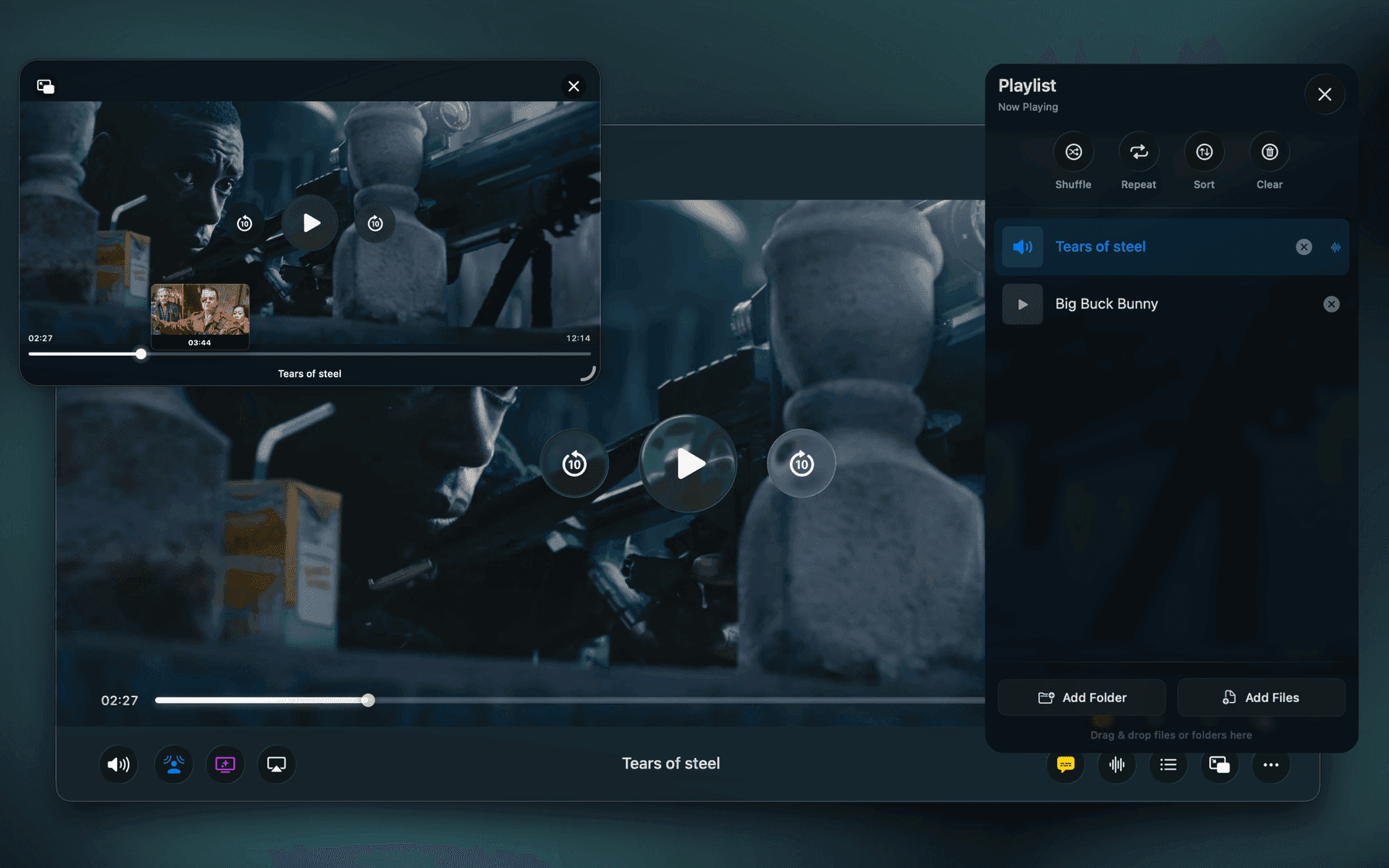
When people hear “spatial audio,” they usually think of AirPods Pro or high-end gaming headsets. In reality, spatial audio isn’t about the headphones, it’s about the processing.
While building Vidi, I implemented a spatial audio engine that works with any headphones: wired, Bluetooth, earbuds, or over-ear. Here’s how it works and why it matters.
Why Surround Sound Breaks on Headphones
Most films are mixed in 5.1 or 7.1 surround, designed for speakers placed physically around a room. On headphones, many players simply collapse everything into stereo.
The result? Dialogue loses focus, front and rear sounds blur together, and the mix feels flat. Some players try to fake surround with reverb or volume tricks, but that usually just sounds hollow and unnatural.
How Spatial Audio Actually Works
True spatial audio uses binaural processing — the same cues your brain uses to locate sound in the real world.
Tiny differences in timing, intensity, and frequency between your ears tell your brain where a sound is coming from. These cues are modeled using Head-Related Transfer Functions (HRTFs). By applying HRTFs to each channel of a surround mix, you can recreate 3D positioning on regular stereo headphones.
Making It Work in Real Time
For video playback, this has to happen live, with virtually no latency. In Vidi, that involves four key steps:
-
Multichannel decoding: Surround formats are decoded into individual channels.
-
HRTF-based positioning: Each channel is placed in 3D space, so dialogue sits in front of you and ambient sounds surround you naturally.
-
Low-latency processing: The full pipeline runs in under 10ms, keeping audio perfectly in sync with video.
-
Universal output: Because it’s all software-based, it works with any headphones, not just specific hardware.
Why It Makes a Real Difference
With well-mixed content, the difference from standard stereo is immediate and dramatic:
-
Clearer dialogue: Center-channel voices stay focused and intelligible.
-
More immersive action: Directional effects feel grounded in space, not smeared together.
-
Richer ambience: Background sounds regain depth instead of disappearing into stereo.
Not Apple’s Spatial Audio — and That’s the Point
Apple’s spatial audio is impressive, but it depends on specific hardware and proprietary formats. Vidi takes a different approach: apply proper binaural processing to the surround audio that’s already in your movies.
There’s no head tracking as of now — the soundstage moves with your head — but for video playback, where you’re facing the screen anyway, that’s a reasonable tradeoff.
The Rest of Vidi’s Audio Suite
Spatial audio is just one part of Vidi. It also includes:
-
Voice Boost: Enhances dialogue without harshness.
-
Cinema Effect: Adds low-end weight for impact.
-
Dynamic Sound: Adapts EQ in real time based on the scene.
-
Volume Boost: Clean amplification up to 400% using psychoacoustic limiting.
All of this runs efficiently on Apple’s native audio frameworks.
The Reality
Spatial audio isn’t magic — it’s math, psychoacoustics, and careful engineering. The hard part is making it fast, stable, and efficient across different content and hardware.
After months of iteration, the result is simple: movies sound the way they were meant to, even on ordinary headphones.